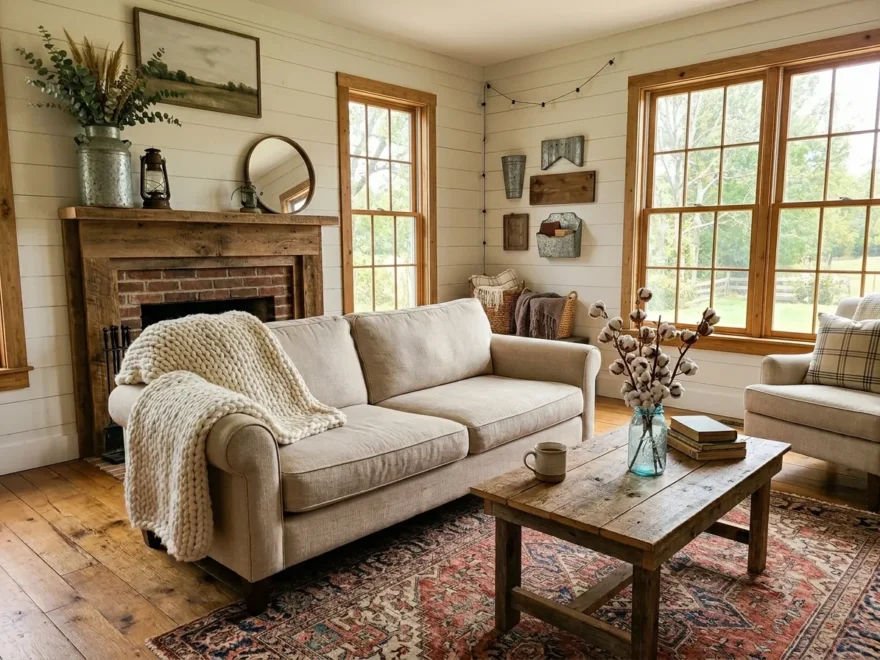
Farmhouse decor ideas is one of those styles that feels lived-in and loved from day one. It’s about mixing old and new, rough and soft, simple and warm. You don’t need a big budget or a designer. You just need to know which pieces to reach for and how to layer them so a room feels like home. Whether you’re working with a small apartment or a sprawling house, these 18 ideas will help you bring that cozy, grounded farmhouse feeling into every corner. If you’re also exploring luxury room decor ideas, combining rich textures, layered lighting, statement furniture, and carefully chosen accents can help create a space that feels elegant, polished, and comfortably upscale without losing warmth or personality.
1. Hang Shiplap Panels on One Wall
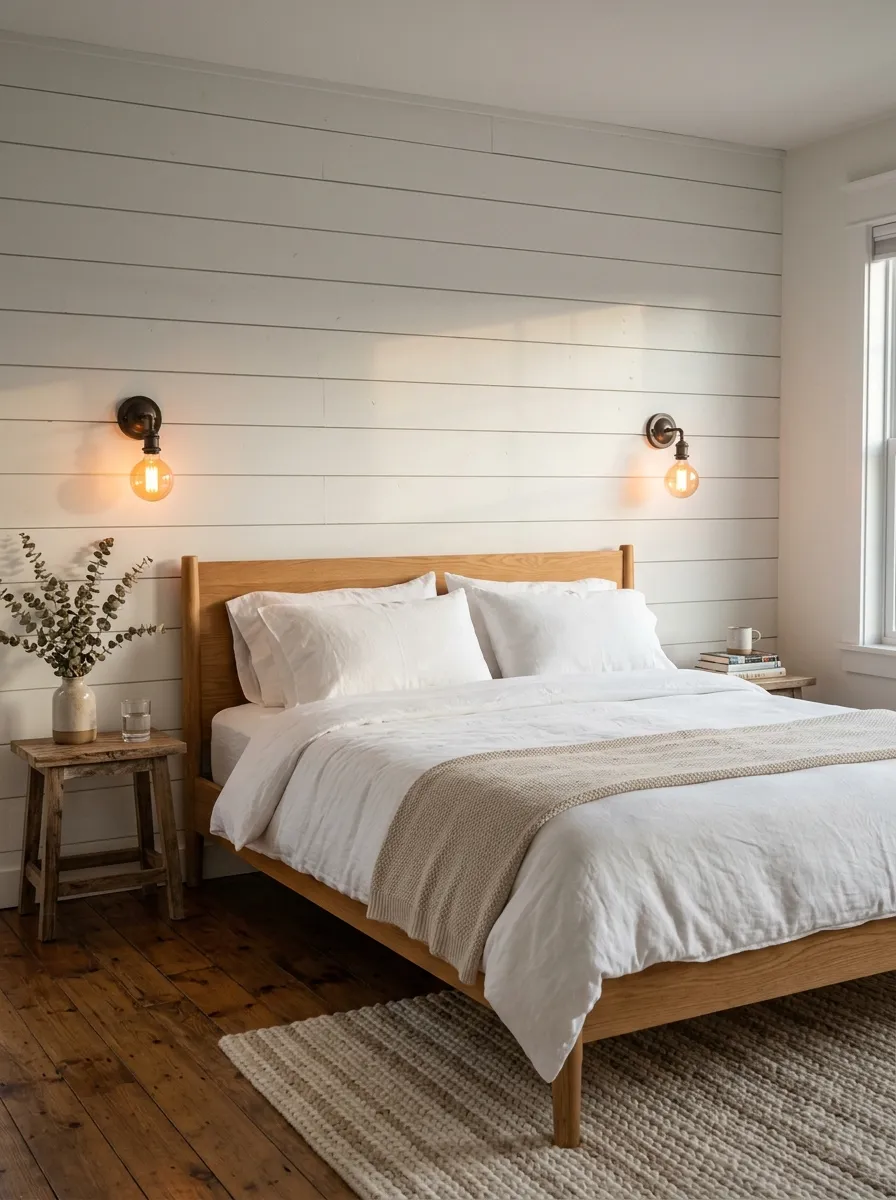
Shiplap is one of the most recognizable farmhouse features. The good news? You don’t need to panel an entire room.
Pick one wall, usually behind a bed or sofa, and apply pre-primed shiplap boards horizontally. You can find tongue-and-groove planks at most home improvement stores for about $1 to $2 per square foot.
Paint them white or warm cream for that classic look. Or try a soft sage green if you want something a little different.
DIY tip: Use a level and a nail gun. Start from the bottom and work up. Leave a small gap between boards using a coin as a spacer for that authentic look.
The texture alone changes a room. Even painted the same color as your other walls, shiplap adds depth that flat drywall simply can’t.
It works in bedrooms, bathrooms, kitchens, and living rooms. It’s one of the most affordable ways to make a big impact fast. One wall is all you need to anchor the entire farmhouse feel of a space.
2. Swap Out Cabinet Hardware for Black Iron Pieces
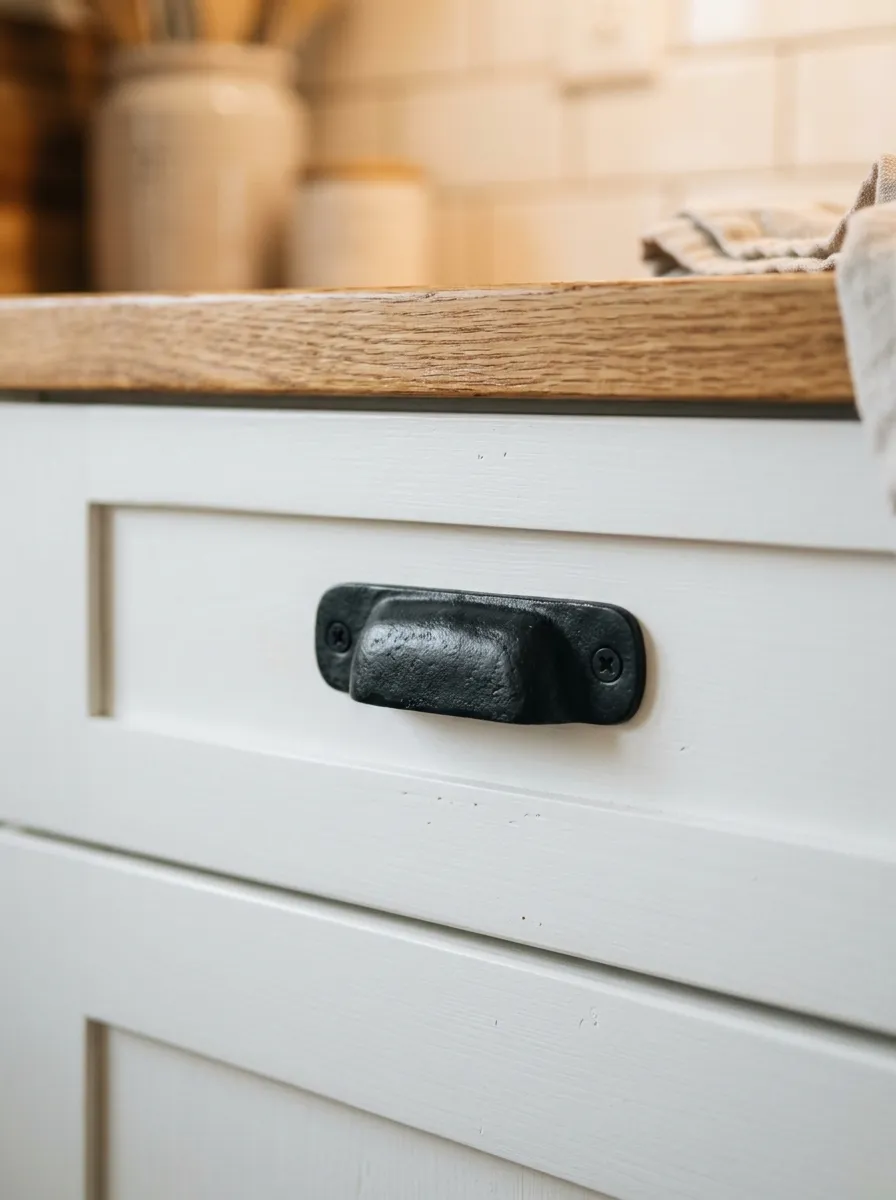
Cabinet hardware is one of the cheapest upgrades you can make. Yet it changes the entire personality of a kitchen or bathroom.
Ditch the old brass or chrome pulls. Replace them with matte black iron hardware bin pulls, cup pulls, or simple bar handles.
A full set of kitchen cabinet hardware typically costs $30 to $80 depending on how many cabinets you have. Individual pulls run $3 to $8 each at most hardware stores.
The dark metal pops beautifully against white, cream, or light gray cabinets. It reads as rustic and grounded without trying too hard.
DIY tip: Use a template card (often included with hardware packs) to mark screw holes consistently. A hand drill is all you need. The whole kitchen can be done in under two hours.
This update works especially well when paired with open shelving or wood accents nearby. The contrast between soft painted surfaces and dark metal is a core farmhouse combination.
Don’t overlook bathroom vanities, dressers, and hutches either. Swapping hardware there creates a cohesive look throughout the whole home without a full renovation.
3. Style Open Shelves with Simple, Practical Items
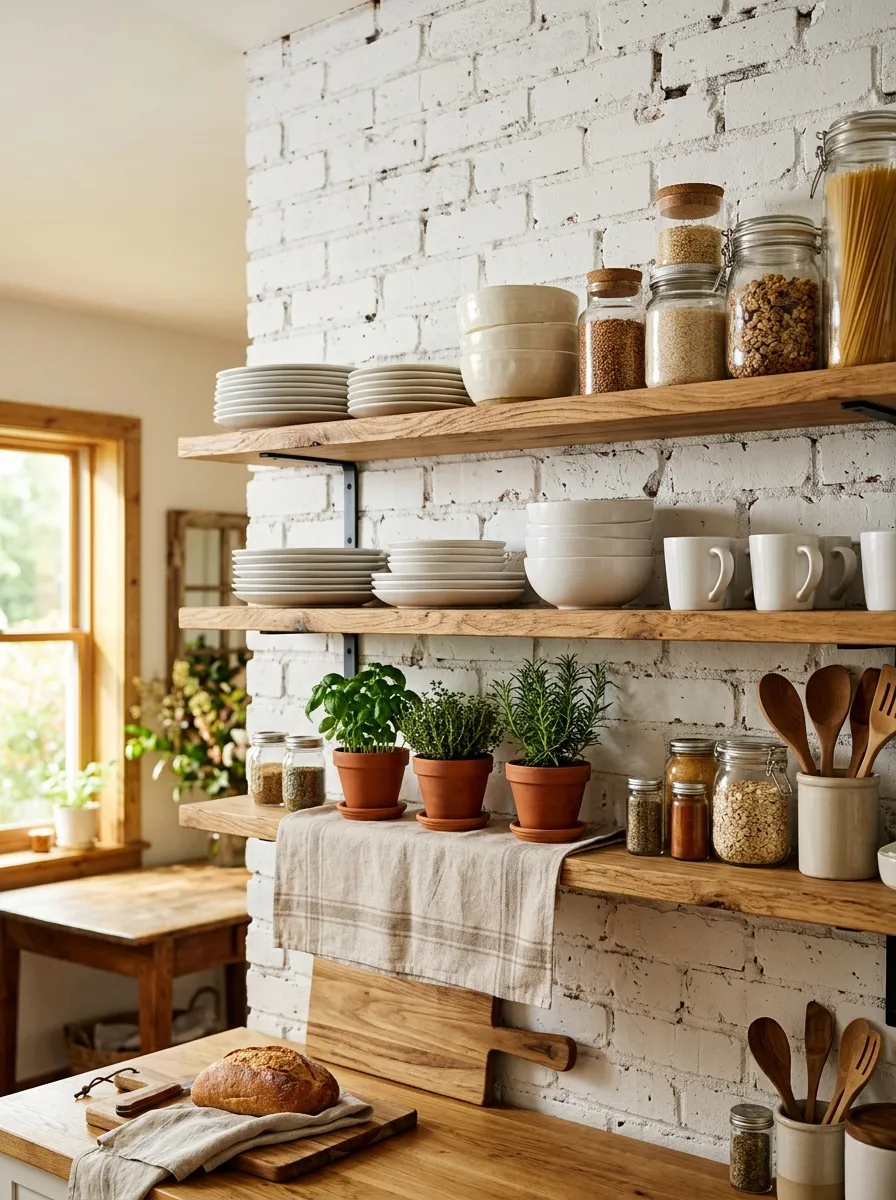
Open shelving is a farmhouse staple. It keeps things accessible and makes a kitchen feel personal and lived-in.
The key is not to overthink it. You don’t need perfectly matched sets of dishes. What you need is a mix of texture, height, and repetition.
A few practical guidelines:
Stack white ceramic plates and bowls together. Group glass jars filled with dry goods like pasta, rice, or oats. Add one or two small plants or herb pots. Tuck in a linen dish towel or a small wooden cutting board.
Budget tip: Shop thrift stores for mismatched white ceramics. A set of five white plates from Goodwill might cost $4 total. They look more authentic than a matching store-bought set.
Keep the shelves working for you. If you actually use what’s on them, the styling takes care of itself.
Avoid cramming shelves too full. A little breathing room makes everything look intentional. Pull out one or two items that don’t belong and the whole shelf composition improves immediately.
Open shelves also work well in living rooms holding books, candles, small baskets, and simple decor objects.
4. Bring In a Reclaimed Wood Coffee Table
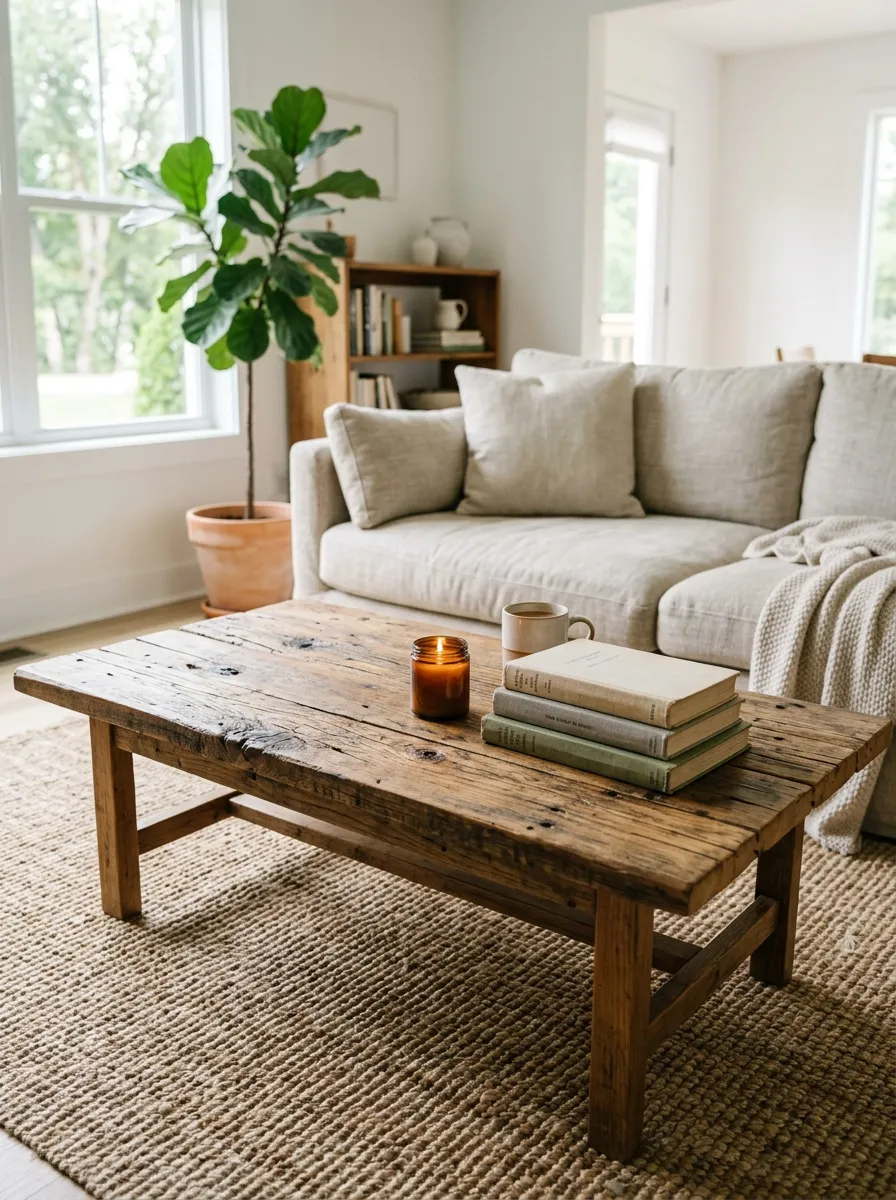
Nothing says farmhouse quite like a piece of reclaimed wood sitting at the center of a room.
A reclaimed wood coffee table carries history. The knots, cracks, and color variation in old wood are things you simply can’t replicate with new material.
You can buy reclaimed wood tables at most furniture stores or online marketplaces for $150 to $400. Or you can build one yourself for a fraction of that.
DIY tip: Buy a slab of reclaimed barn wood from a salvage yard (usually $20 to $60), sand it lightly, apply a coat of clear wax or natural oil, and attach simple hairpin legs from Amazon ($25 to $40 for a set of four). The whole project runs under $100.
Style the table simply. A small candle, a stack of three books, a small tray, and a single dried stem in a small vase is all you need.
Avoid cluttering the surface. The beauty of the wood grain deserves space to breathe.
This one piece can anchor an entire living room and set the tone for every other farmhouse choice you make.
5. Use a Vintage Ladder as a Blanket Holder
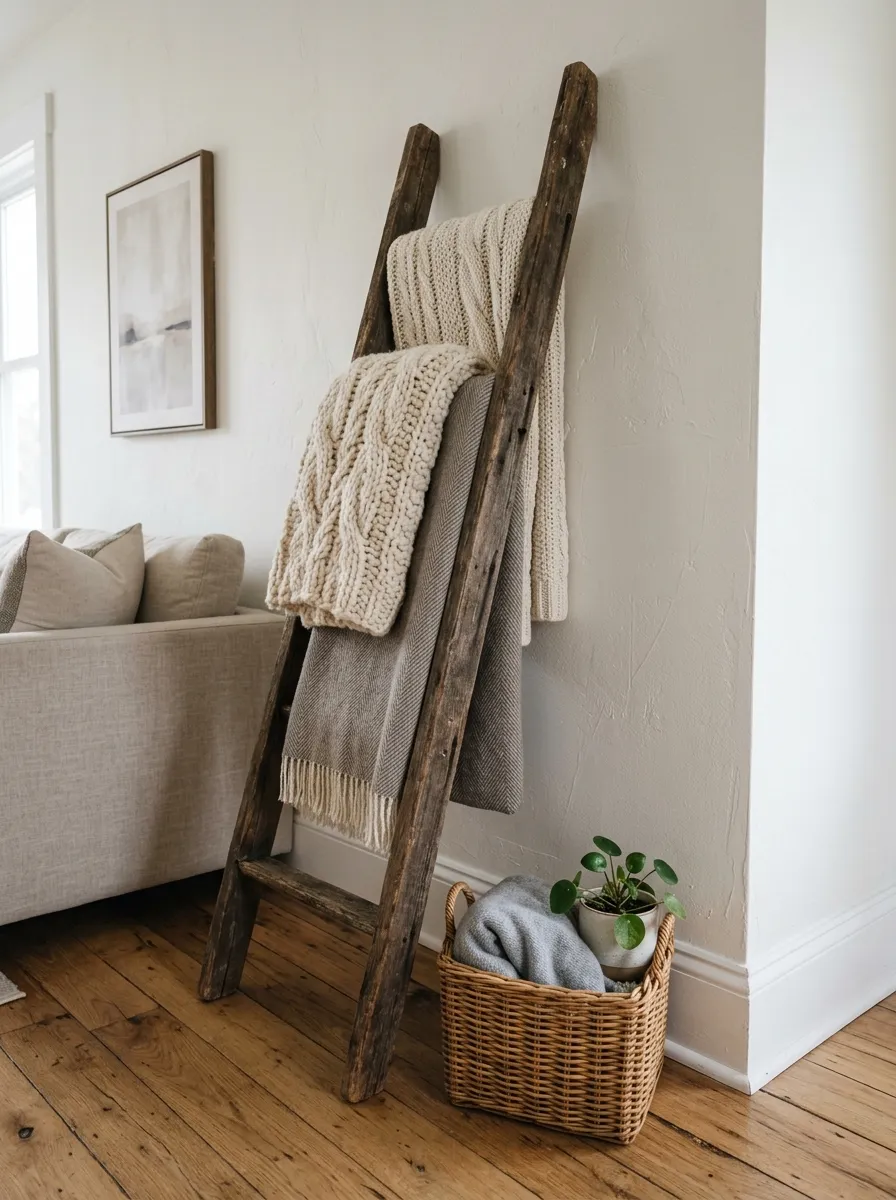
A vintage wooden ladder might be the most affordable farmhouse decor piece you’ll ever find.
Check estate sales, barn sales, thrift shops, or Facebook Marketplace. Old wooden ladders often sell for $5 to $20. Sometimes people give them away.
Sand off any rough edges. Leave the original paint chipping if it looks good. Or apply a coat of white or gray milk paint for a cleaner look.
Lean it against a wall in your living room or bedroom and drape two or three chunky knit or woven throws over the rungs.
It gives you easy access to blankets. It fills an awkward corner. And it adds vertical interest to a room without taking up floor space.
Styling tip: Let one throw hang lower than the others. Fold one neatly over a top rung and let another drape loosely. Vary the textures — one chunky knit, one woven cotton, one linen.
This piece works in bathrooms too. Hang rolled towels over the rungs and lean it beside the tub or vanity.
Simple, free, and functional. That’s about as farmhouse as it gets.
6. Add a Galvanized Metal Tray to Your Tablescape
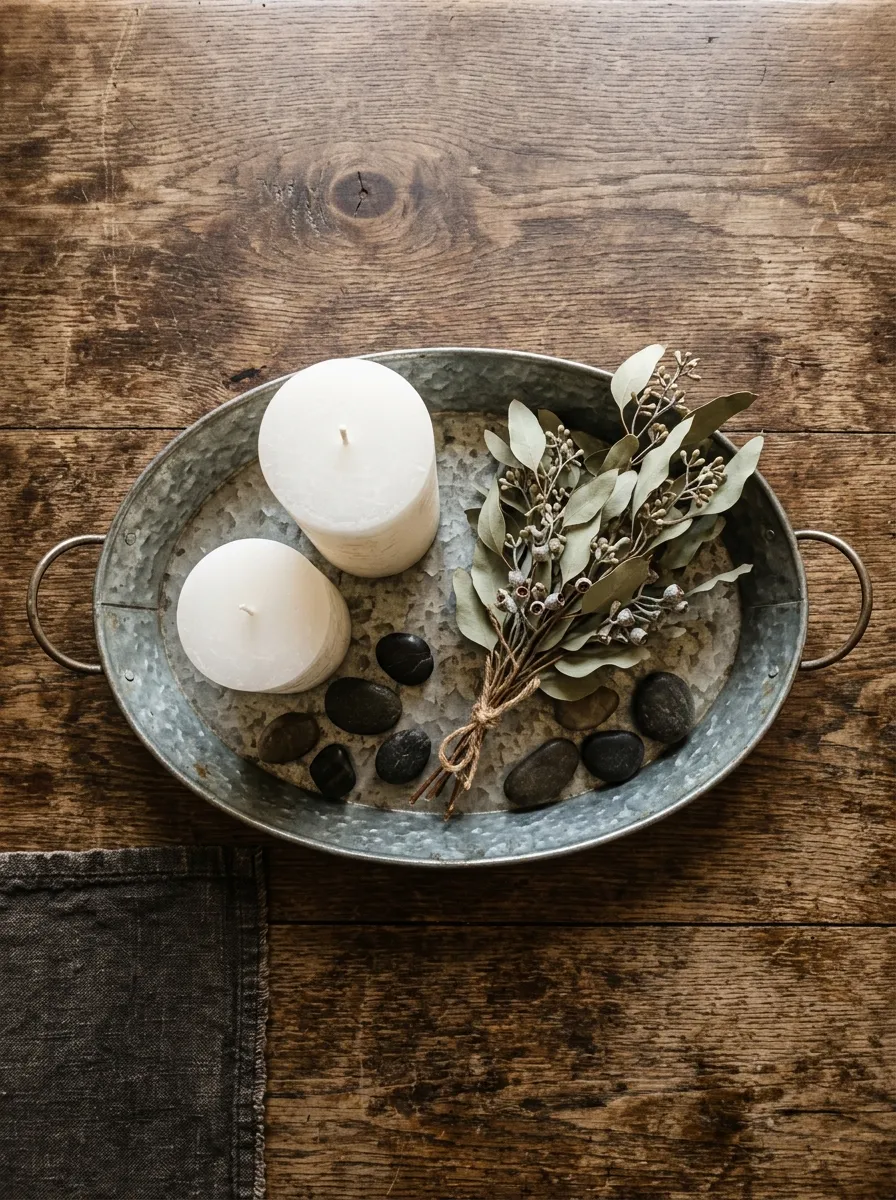
Galvanized metal is one of those materials that makes everything look more farmhouse immediately.
A simple galvanized tray from a farm supply store or home goods shop costs $10 to $25. It’s one of the most useful and affordable pieces in farmhouse decor.
Use it to group objects on a coffee table, dining table, or kitchen counter. A tray corrals small items and makes a collection look intentional rather than cluttered.
Inside the tray, try two white candles of different heights, a small bundle of dried botanicals, and a smooth stone or two. That’s all you need.
The raw, industrial texture of galvanized metal plays perfectly against soft linens, wood grain, and ceramic.
Budget tip: Check Tractor Supply Co. or Rural King for galvanized buckets, trays, and containers. Prices are often lower than home decor stores for the exact same look.
You can also use galvanized metal pots as planters for herbs in the kitchen window or on a porch. The same tray that holds candles in winter can hold a small succulent arrangement in spring.
One tray. Endless uses. Perfect farmhouse energy.
7. Hang Linen or Burlap Curtains
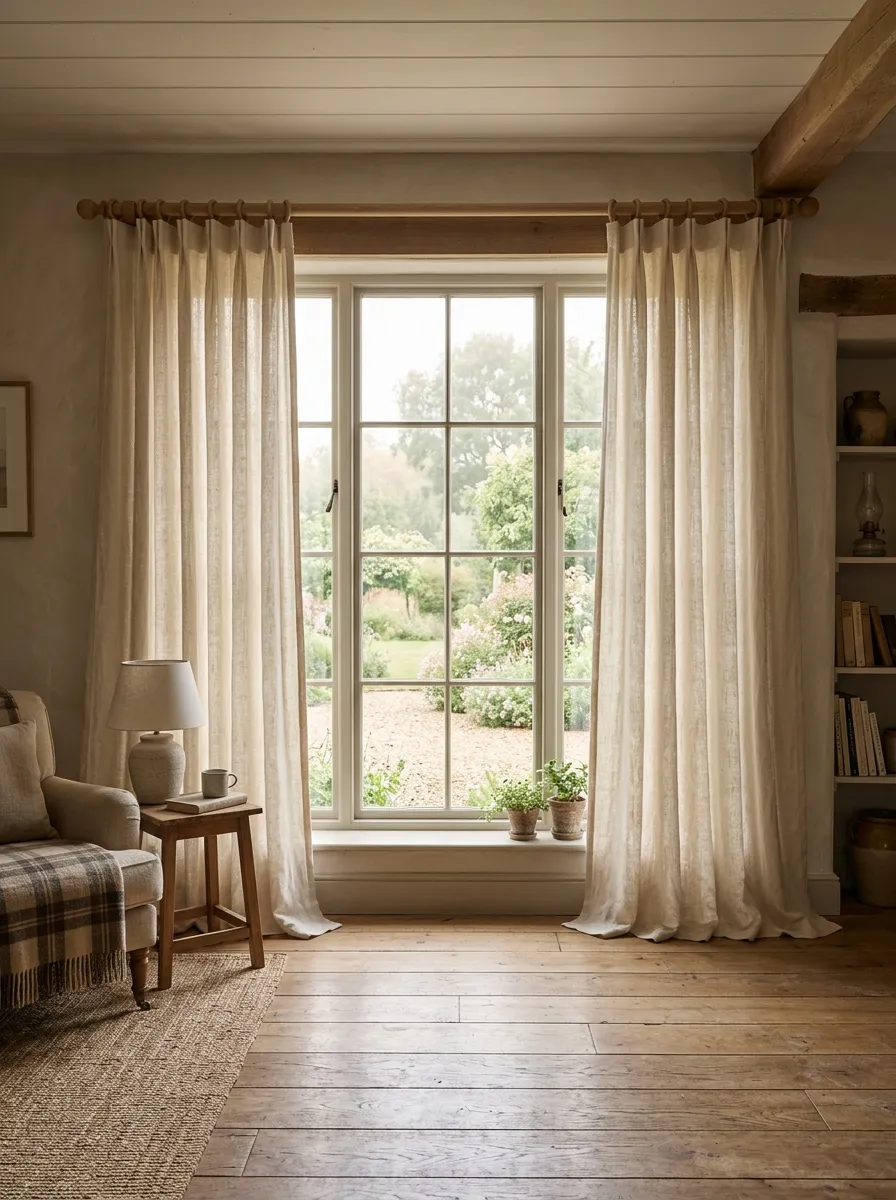
Curtains matter more than most people think. They frame a window and change the scale of a whole room.
For farmhouse style, reach for natural fiber curtains in linen, cotton canvas, or burlap. The texture is everything. These fabrics let light filter through softly and hang with a natural, relaxed drape.
Avoid synthetic fabrics that look stiff or plasticky. Avoid busy patterns in this context. Solid natural tones work best.
Color guide: Warm white, cream, oatmeal, soft gray. These all work. Darker tones like charcoal linen also look great in a room that needs grounding.
Hang the rod close to the ceiling, not just above the window frame. This makes ceilings feel taller and windows feel larger.
Budget tip: IKEA’s AINA linen curtain panels cost about $20 each. They have exactly the right look and hang beautifully. For 90-inch panels, look at Amazon or Target’s threshold linen collection.
Use simple wooden or iron curtain rods with basic rings. Skip decorative finals that compete with the fabric.
Let the curtains pool just slightly on the floor for a soft, relaxed look. It’s an easy detail that reads as effortful without actually being difficult.
8. Display Dried Botanicals in Simple Vessels
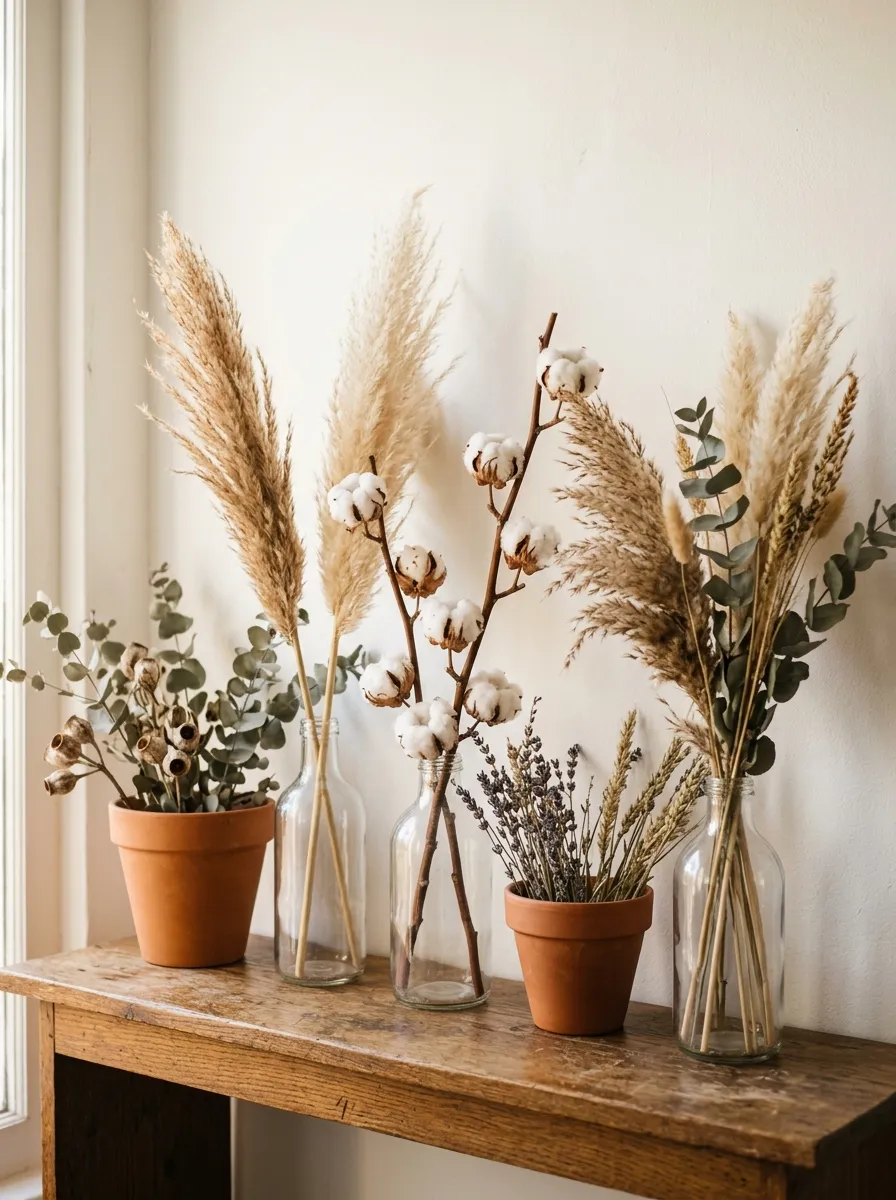
Dried botanicals have completely taken over farmhouse decor, and for good reason. They require zero maintenance and look beautiful for years.
The most popular choices are pampas grass, dried cotton stems, dried lavender, bunny tail grass, and wheat stalks. You can find these at craft stores, Trader Joe’s, or online.
You don’t need expensive vases. Clear glass bottles, old mason jars, terracotta pots, and small galvanized cans all work perfectly. The container should be simple so the botanical is the star.
Cost breakdown: A bundle of pampas grass from Hobby Lobby (with 40% off coupon) runs about $6 to $9. Cotton stems are similar. One bundle can fill two or three vessels.
Style them in odd numbers — three vessels together looks more natural than two or four. Vary the heights.
A few dried stems in a tall glass bottle on a kitchen shelf costs almost nothing and looks like something from a styled photoshoot.
They don’t wilt, don’t drop petals, and don’t need water. For renters or people who travel often, they’re a perfect solution.
Swap them seasonally if you like, but most dried botanicals look good year-round.
9. Layer Rugs for Texture and Warmth
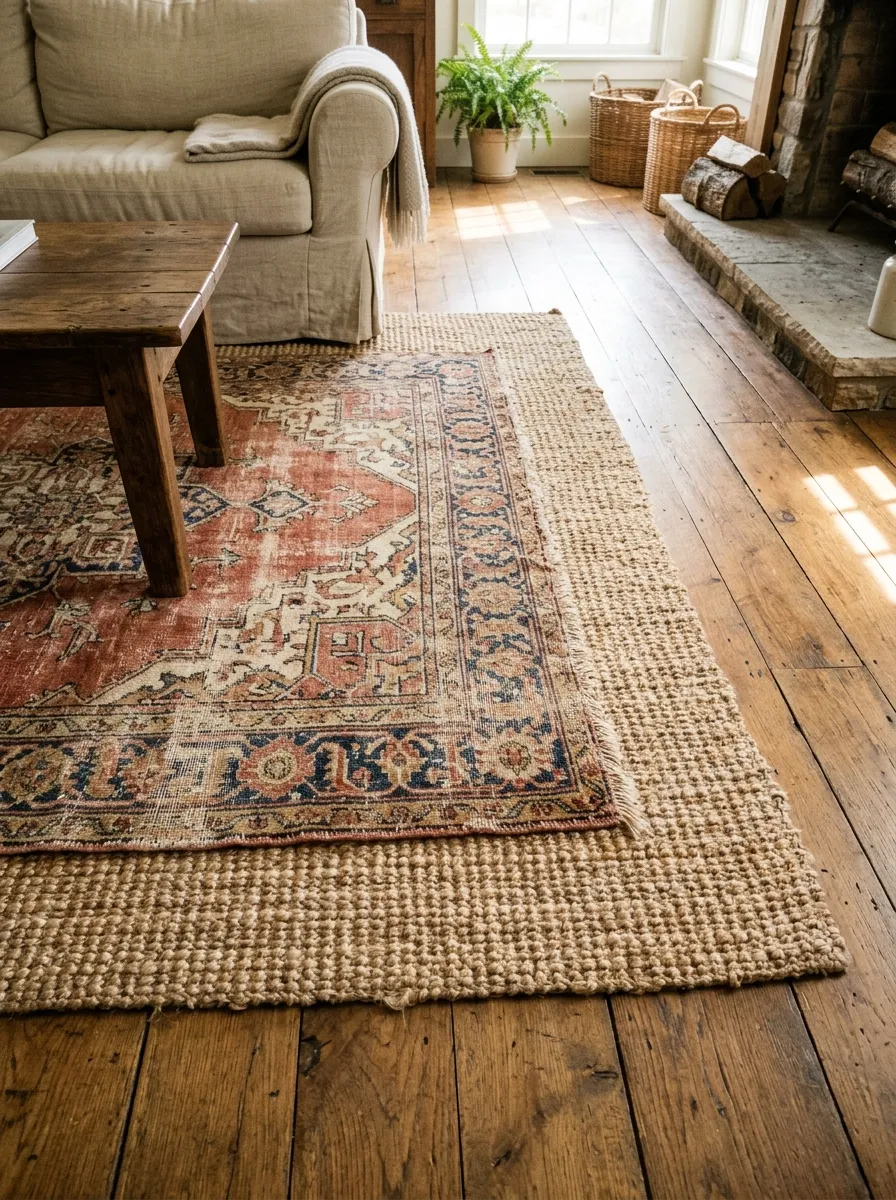
Layering rugs is one of those tricks that looks expensive but really isn’t.
The formula is simple: a large flat-weave or jute rug as the base, topped with a smaller patterned or textured rug on top.
The base rug sets the size of the seating area. The top rug adds personality and color. Together they create visual depth that a single rug never achieves.
For farmhouse style, start with a jute or sisal rug in a natural tone. Then layer a worn, vintage-looking flat-weave, a cowhide, or a faded Persian-style rug on top.
Budget tip: Jute rugs are among the most affordable on the market. An 8×10 jute rug from Amazon or Ruggable starts at $80 to $130. Layer a $40 to $60 smaller vintage-look rug from HomeGoods or World Market on top.
Make sure the top rug is centered within the seating area. It should anchor the furniture grouping, not float off to one side.
Layered rugs also help in rentals where you can’t change flooring. They warm up cold tile or hide worn carpet without any permanent changes.
The texture contrast between a flat jute base and a softer piled rug is one of the most satisfying farmhouse combinations in any room.
10. Put Up a Wooden Beam on the Ceiling
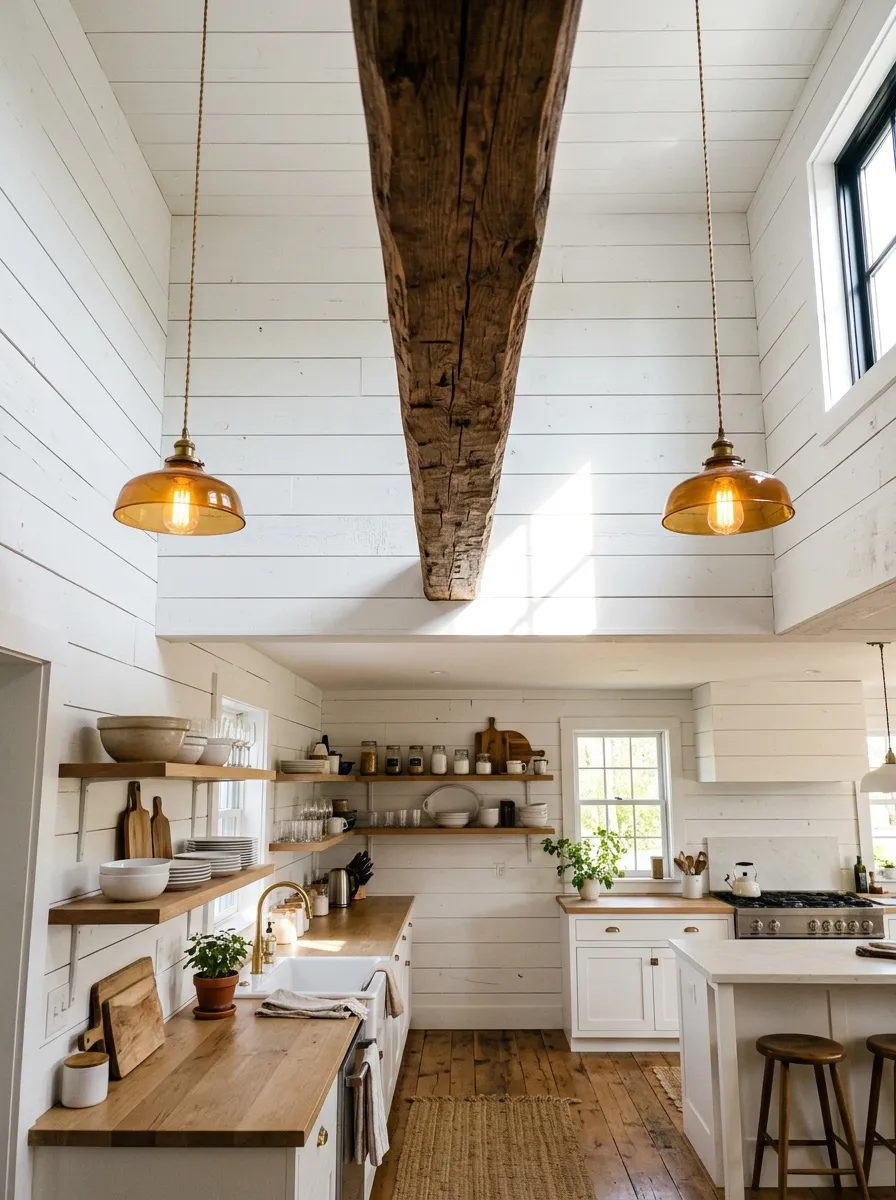
A ceiling beam changes a room dramatically. It adds architectural character that most modern homes completely lack.
The good news: you don’t need structural beams. Decorative faux wood beams are hollow, lightweight, and install with simple brackets and construction adhesive.
They look completely real once installed. Cost runs from $50 to $150 per beam depending on length and style.
For a farmhouse kitchen or living room, one or two beams running the length of the ceiling is all you need. You can also do a simple boxed beam treatment or just a single center beam.
DIY tip: Measure your ceiling span. Order a hollow beam kit. Attach a 2×4 ledger board to the ceiling along the beam path. Snap the hollow beam over it and secure from underneath. Paint or stain to match your preferred wood tone.
Choose a beam that’s proportional to your ceiling height. In a room with 8-foot ceilings, a 4 to 6 inch wide beam works well. Higher ceilings can take something larger.
Pair a beam with a simple pendant light hanging nearby and the combination reads as very intentional farmhouse design. It’s one of the more committed changes on this list but also one of the most rewarding.
11. Frame Vintage Seed Packet or Botanical Prints
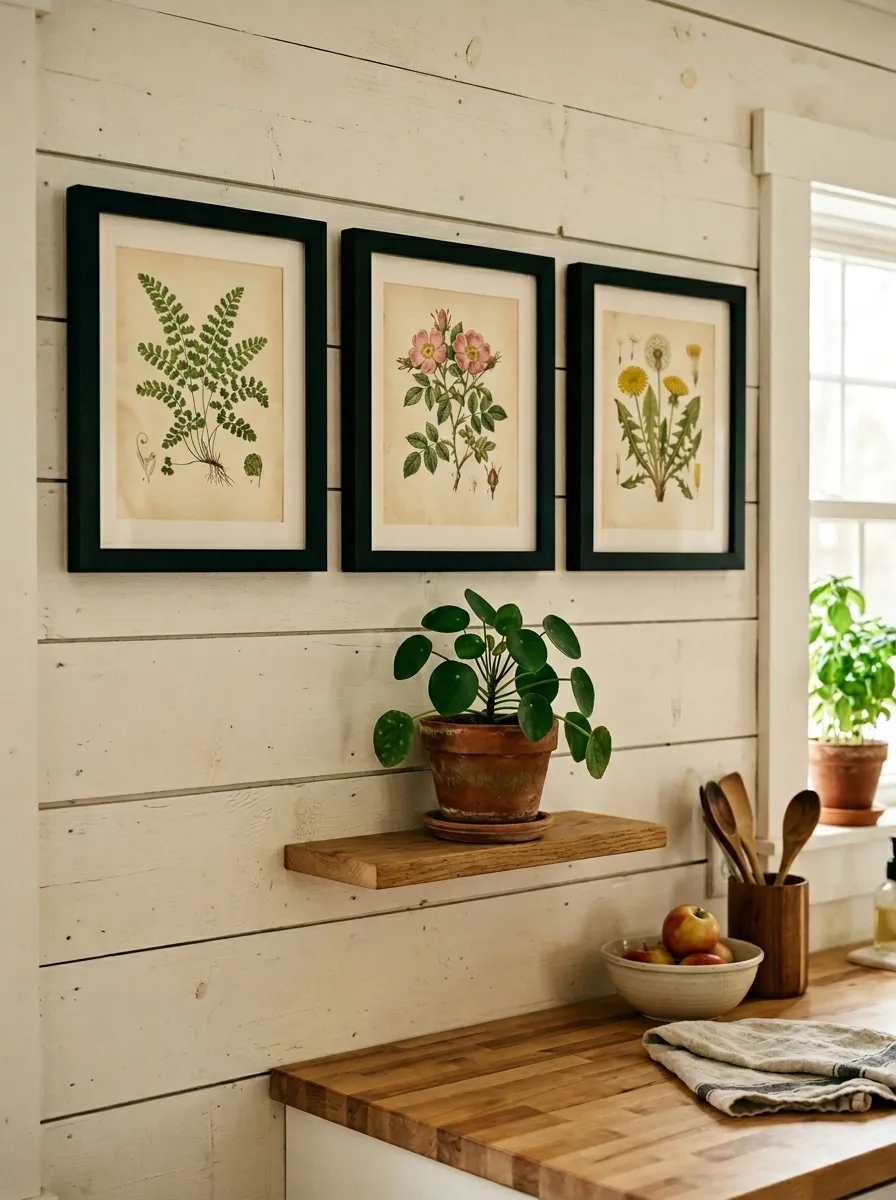
Wall art doesn’t need to cost a lot. Some of the most charming farmhouse wall displays cost under $20 total.
Vintage seed packet prints, botanical illustrations, farm animal line drawings, and old map fragments all work beautifully in farmhouse spaces.
Where to find them for free or cheap:
Sites like Pixabay, Unsplash, and the Library of Congress digital archive offer public domain botanical prints and vintage illustrations you can download and print at home. A print shop like Staples or Office Depot can print an 8×10 for about $1 to $3.
Buy simple black or natural wood frames from IKEA or the dollar store. Mat them in white for a more finished look.
Gallery wall tip: Stick to one color of frame throughout — all black, all natural wood, or all white. The variety in the prints themselves provides enough visual interest without competing frame colors adding confusion.
Group three to five prints together in a loose cluster. They don’t need to be perfectly aligned. A slight diagonal flow feels more natural than a rigid grid.
This is one of the easiest ways to fill blank walls with something personal and charming without spending money on mass-produced art.
12. Add a Farmhouse Sink to Your Kitchen
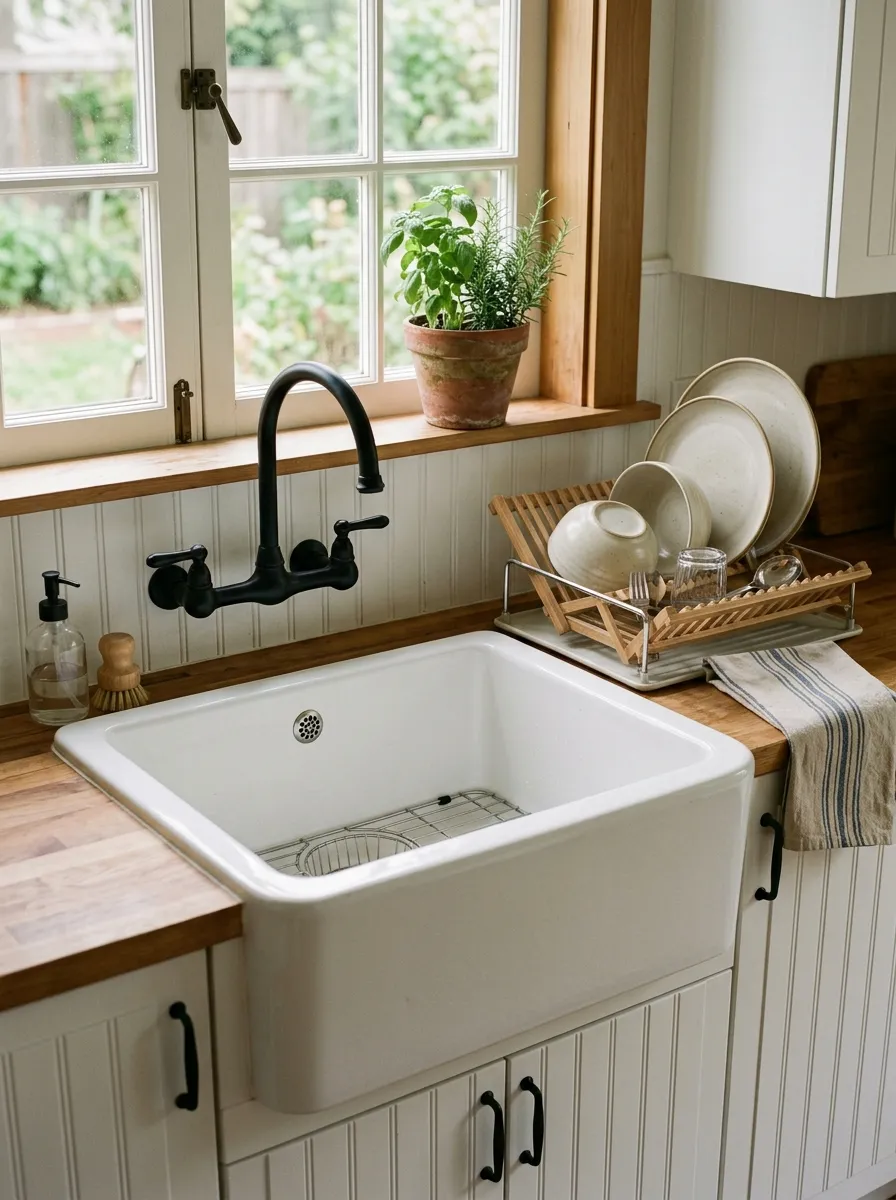
The apron-front farmhouse sink is one of the most iconic features of this style. It’s a bigger investment than most items on this list, but worth mentioning because it transforms a kitchen.
A white cast iron or fireclay farmhouse sink runs $300 to $700 for the sink itself. Installation adds labor costs if you don’t DIY.
That said, there are more budget-friendly composite versions that start around $150 to $200 and still capture the look.
Pair an apron sink with a matte black or brushed brass faucet for a cohesive farmhouse finish.
The deep basin is also extremely practical. It fits large pots, cookie sheets, and oversized cutting boards that standard sinks struggle with.
Realistic note: This swap requires some plumbing adjustment since farmhouse sinks sit differently in base cabinets. If you’re already planning a kitchen update, it’s worth the extra step. If you’re not, the other items on this list deliver a lot of the same feeling at far less cost.
For renters, a farmhouse sink obviously isn’t possible. But knowing what the signature features are helps you prioritize when you do have a chance to choose or customize your own space.
13. Use Mason Jars as Organizers and Vases
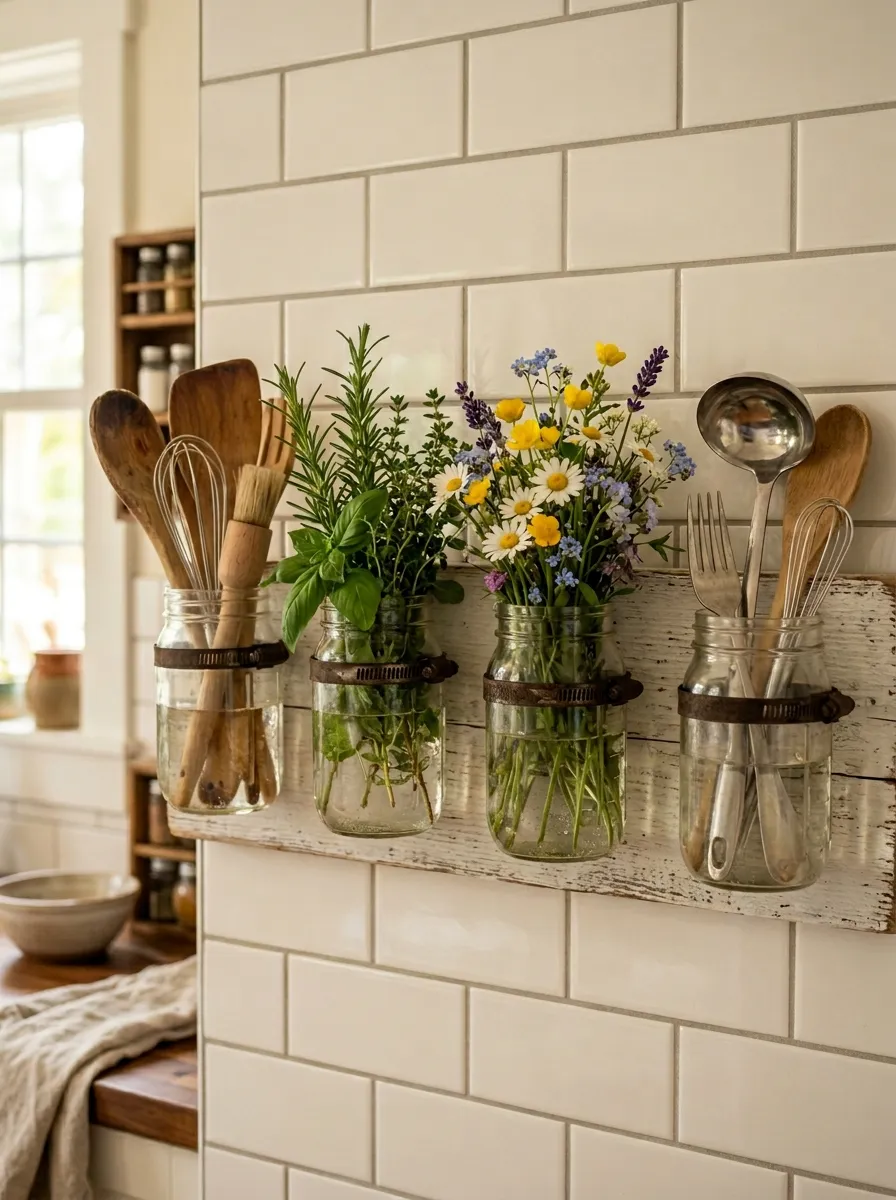
Mason jars are so tied to farmhouse style that it’s almost a cliché. But they keep appearing because they genuinely work.
They’re inexpensive, practical, and look good in almost every room.
In the kitchen: use wide-mouth quart jars to hold utensils on the counter or to store dry goods on open shelves.
In the bathroom: use them to hold cotton balls, Q-tips, bath salts, or a small plant cutting in water.
On a dining table: a few jars holding wildflowers or dried stems make a simple centerpiece that costs almost nothing.
Wall-mounted mason jar organizers are easy to make. Screw pipe clamps or hose clamps (from the hardware store, $1 to $2 each) to a piece of reclaimed wood. Slide a jar into each clamp. Mount the board to the wall. Done.
This DIY costs about $10 to $15 total and gives you a functional herb holder, utensil rack, or flower display.
Budget tip: Ball mason jars are available at Walmart and most grocery stores. A 12-pack of wide-mouth quart jars runs about $12.
Simplicity is the whole point. The jar does the work.
14. Paint an Accent Wall in a Muted, Earthy Tone
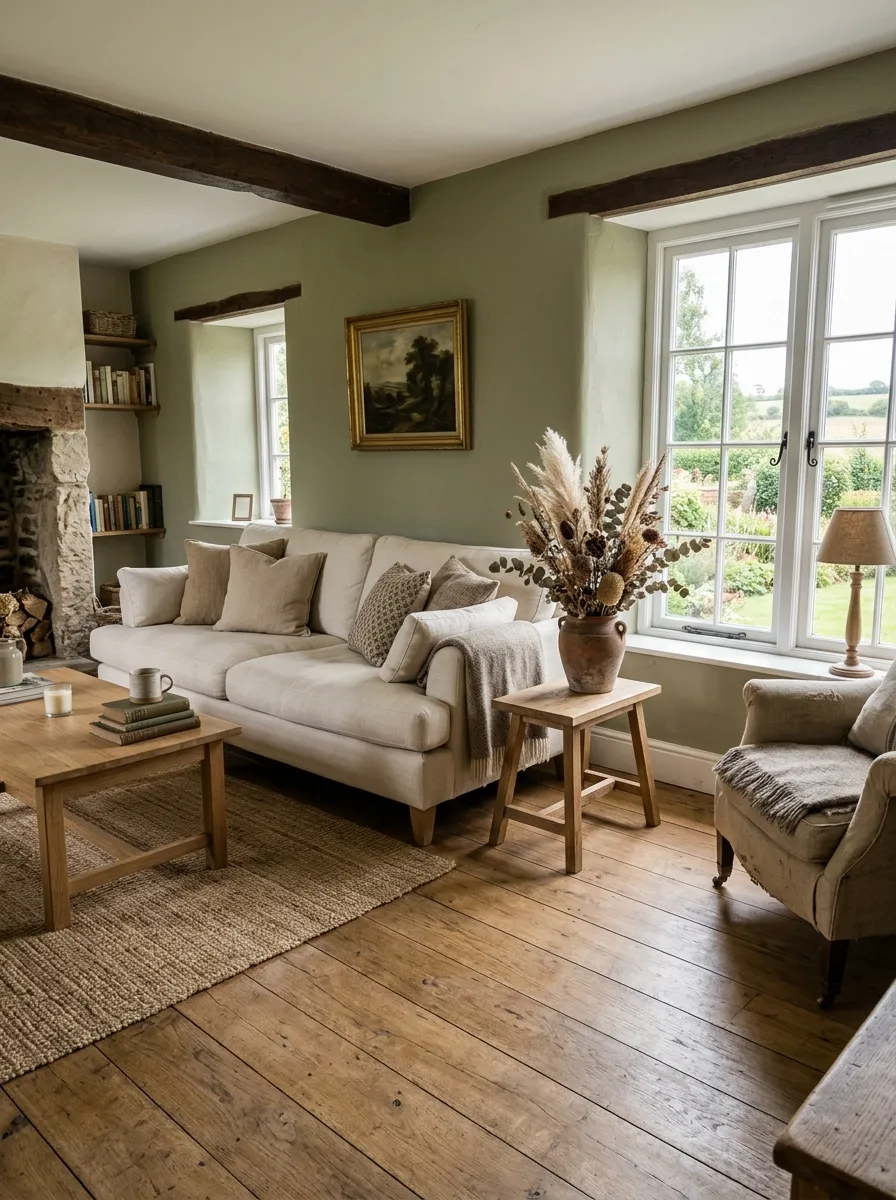
White walls are a farmhouse classic. But one muted accent wall can add a lot of warmth and personality without overwhelming a space.
The key is to stay in the right color family. Warm, earthy, muted tones are what work here. Think soft sage green, warm clay, dusty blue, faded terracotta, or warm greige.
Avoid anything too saturated or bright. The goal is a color that feels worn and natural, as if the wall has been that color for a hundred years.
Good specific paint colors to look up: Sherwin-Williams Sage, Benjamin Moore Pale Smoke, Farrow & Ball Mole’s Breath, or Behr’s Dusty Miller.
Cost: A quart of paint for a single accent wall runs $15 to $25. A gallon covers most full walls and runs $30 to $60.
The accent wall works best on a wall that your furniture naturally points toward, or a wall that doesn’t have windows or doorways interrupting it.
Pair the new wall color with cream or white linens, natural wood, and warm-toned metal accents. This combination will always look considered and calm.
15. Incorporate Woven Baskets Throughout the Home
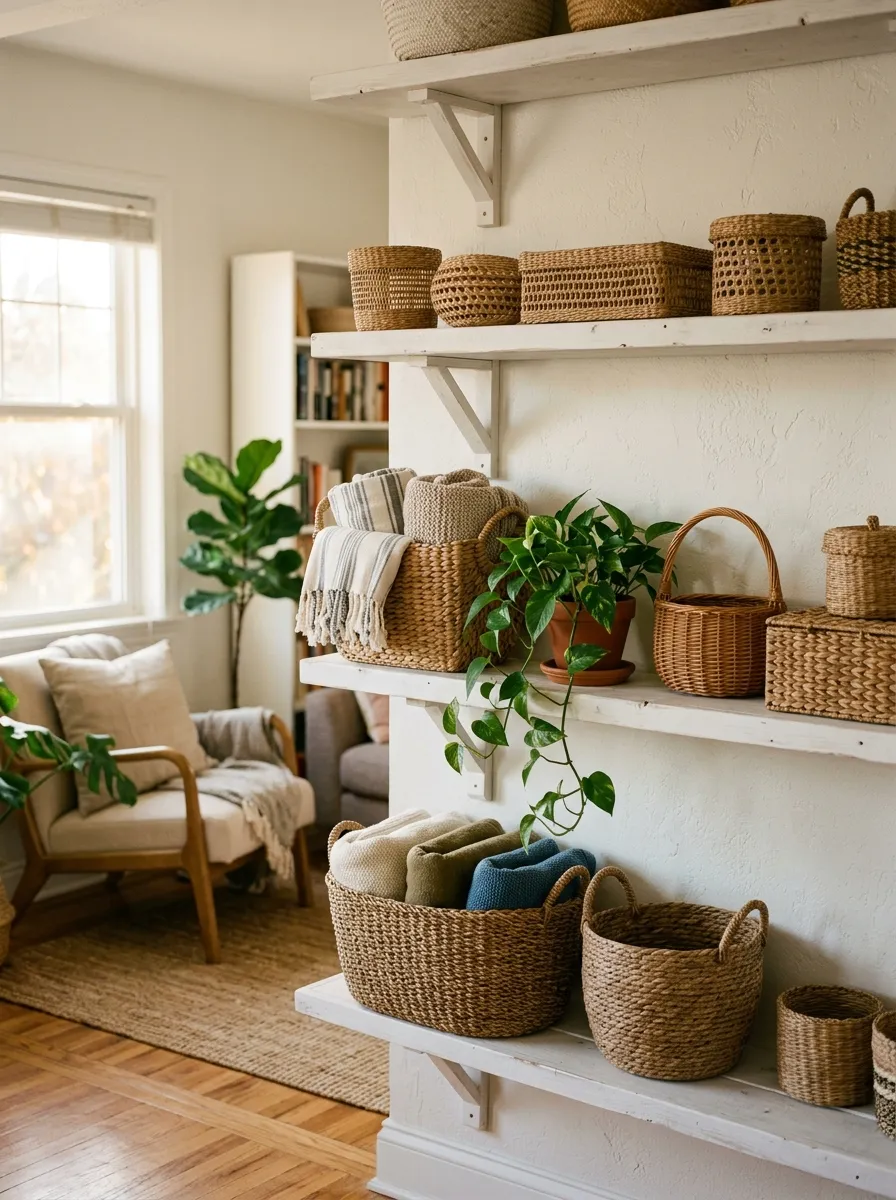
Woven baskets do two things beautifully: they organize clutter and they add organic texture.
You can use them in every room. In the living room, a large seagrass basket holds extra blankets beside the sofa. In a bedroom, medium baskets on shelves hold folded clothes or accessories. In a bathroom, small baskets hold rolled towels or toiletries.
In the kitchen, a basket on the counter can hold fruit, produce, or bread. On a bookshelf, baskets fill in visual gaps and hide things like chargers, remotes, or small clutter.
Where to buy affordably: HomeGoods, TJ Maxx, and World Market usually have a strong basket selection at good prices. Expect to pay $8 to $30 depending on size. IKEA’s KNIPSA and BORSTAD are solid affordable options too.
Mix a few different weave styles — one tighter seagrass weave, one looser rattan, one chunky rope basket. Variety in texture keeps the display interesting.
The natural material of woven baskets connects to the organic, grounded quality that defines farmhouse style. They make any shelf, floor corner, or counter look warmer just by being there.
16. Create a Simple Herb Garden on a Windowsill
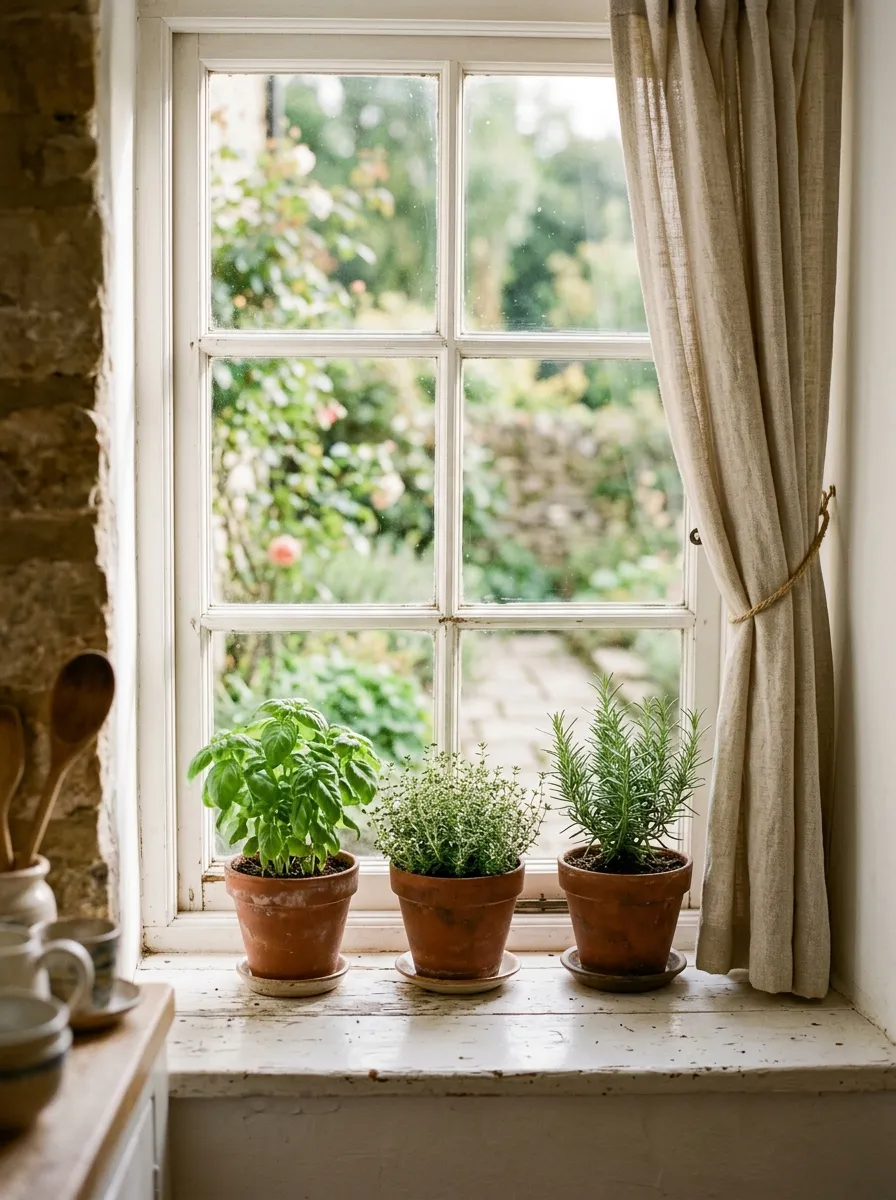
A kitchen windowsill herb garden is one of the most charming and functional things you can add to a farmhouse kitchen.
It’s green. It smells good. And you actually use what’s growing there.
Start with three small terracotta pots. Fill them with potting mix and plant basil, thyme, rosemary, or mint. These are the most forgiving herbs for indoor growing.
Cost: Three 4-inch terracotta pots run about $1 to $2 each. A small bag of potting mix is $4 to $7. Herb plants from a garden center cost $2 to $4 each. Total project: under $20.
Place them on a south-facing windowsill where they’ll get at least 4 to 6 hours of light.
The terracotta pots are perfect for farmhouse style as-is. No painting or decorating needed. The raw earthy tone fits right in.
If you want a little more personality, use a small chalkboard label on a toothpick stuck in the soil to label each herb.
Beyond the kitchen, a few potted herbs on a bathroom windowsill or a living room shelf add life to any room. Small plants in simple pots are one of the easiest ways to make a space feel cared for.
17. Replace a Standard Light Fixture with a Wooden or Rattan Pendant
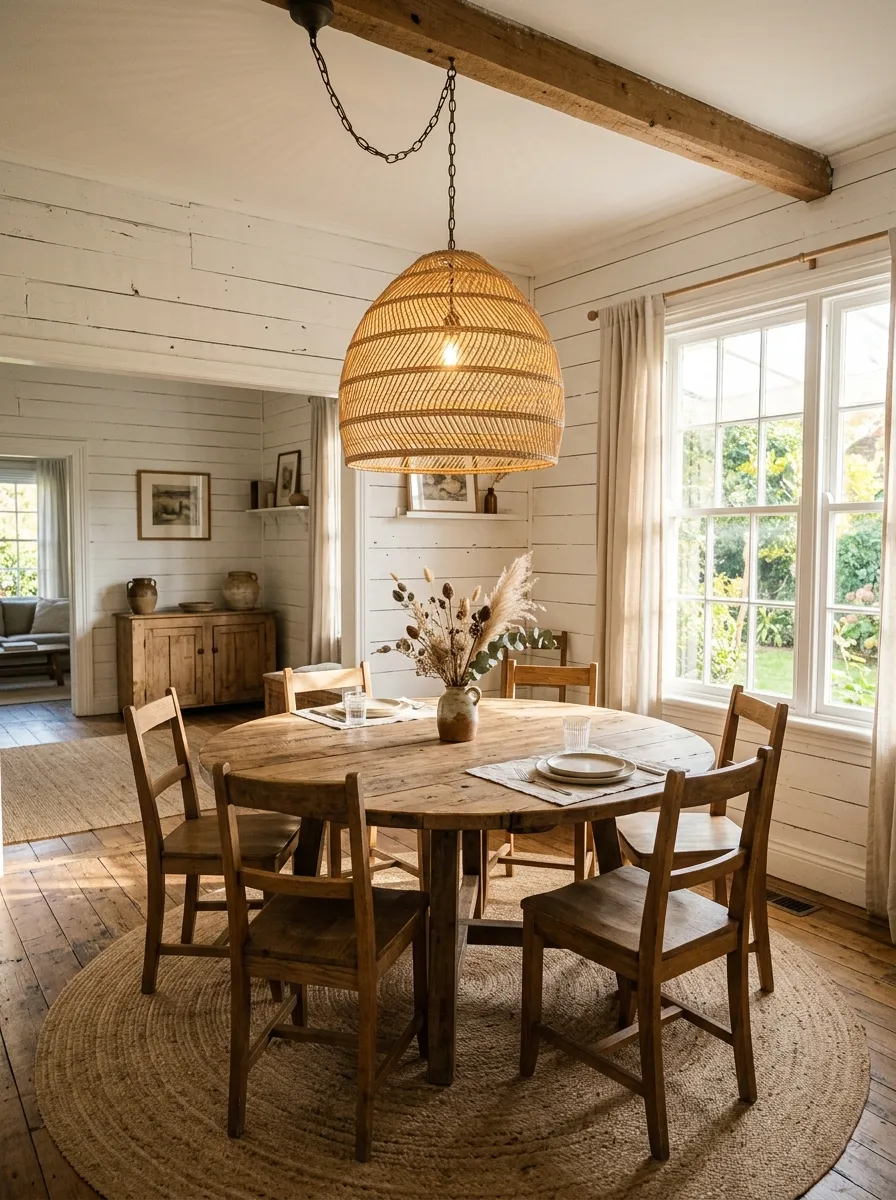
Lighting fixtures are easy to overlook, but they’re one of the highest-impact swaps you can make.
A rattan, woven seagrass, or wood pendant light over a dining table or kitchen island immediately signals farmhouse style. The natural material softens the overhead light and adds warmth that a standard glass globe fixture never does.
Rattan pendant lights are widely available and surprisingly affordable. Expect to pay $40 to $120 for a good-looking option on Amazon, Wayfair, or Etsy.
DIY note: Swapping a pendant light is a doable DIY for most people who are comfortable turning off a breaker and working with basic wiring. The whole job takes under an hour. If you’re not comfortable with electrical work, an electrician can do it in 30 minutes.
For a dining area, hang the pendant so the bottom of the shade sits 30 to 36 inches above the tabletop.
Rattan fixtures also work well in bedrooms over nightstands, in bathrooms above vanities, and in entry hallways.
The material itself is doing all the farmhouse work here. Even a simple, affordable option reads as considered and style-forward in a way that a basic drum shade or pendant globe never does.
18. Style a Wooden Tray on Your Coffee Table
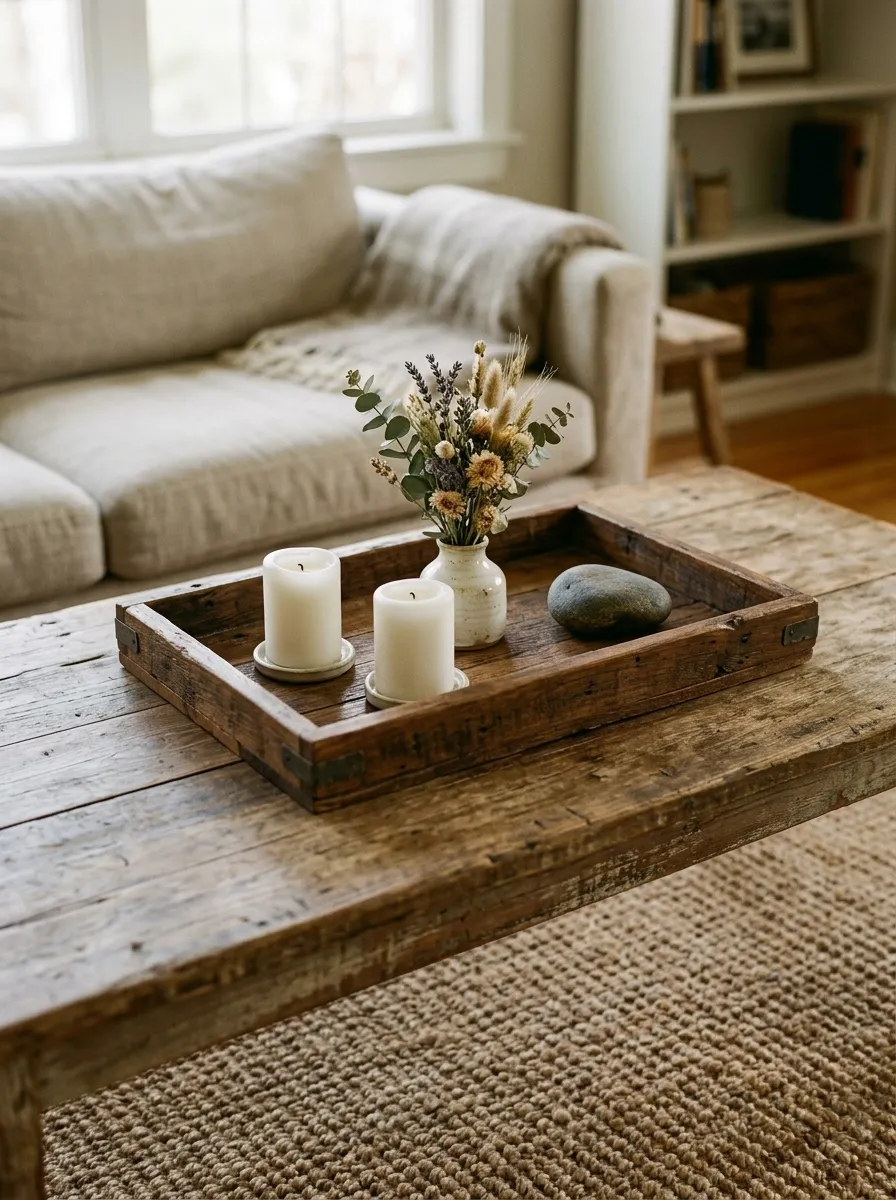
A wooden tray on a coffee table is one of the smallest and most effective farmhouse styling tricks.
It organizes objects. It makes a grouping look intentional. And it gives the eye a place to rest.
Use a reclaimed wood, painted, or natural finish tray — roughly 14 to 18 inches long for most coffee tables. Find these at HomeGoods, thrift stores, or build one yourself from a scrap board and some trim pieces.
Inside the tray, keep it to three to four objects maximum. A combination that always works: two pillar candles of different heights, one small bud vase with a dried stem, and one natural object like a stone, pinecone, or small branch.
Budget tip: Thrift stores often have wooden trays for $2 to $5. Even a cutting board from the dollar section works. The objects inside can be gathered for free outdoors or bought for under $10 total.
Vary the heights of the objects inside the tray. The tallest thing should be roughly twice the height of the shortest thing. That variation creates a natural, pleasing composition.
Change what’s inside the tray seasonally. In fall, swap in small pumpkins and amber candles. In winter, pine branches and silver ornaments. The tray stays. The contents shift. It’s a simple ritual that keeps your space feeling current and cared for.
Conclusion
Farmhouse decor is not about buying a specific look off a shelf. It’s about choosing materials with history, keeping things simple and grounded, and letting texture and warmth do the heavy lifting.
Most of these ideas cost under $50. Several cost nothing at all if you already have the raw materials or know where to look secondhand. The combination of natural wood, woven fibers, muted colors, and practical objects is what makes farmhouse style feel so welcoming and so easy to build over time.
Start with one room. One wall. One tray. One basket. Layer in more pieces as you find them. That gradual, personal accumulation is what makes a farmhouse home feel genuinely lived-in rather than staged.
You don’t need to do everything at once. Pick two or three ideas from this list that excite you most and start there. Your home will tell you what it wants next.